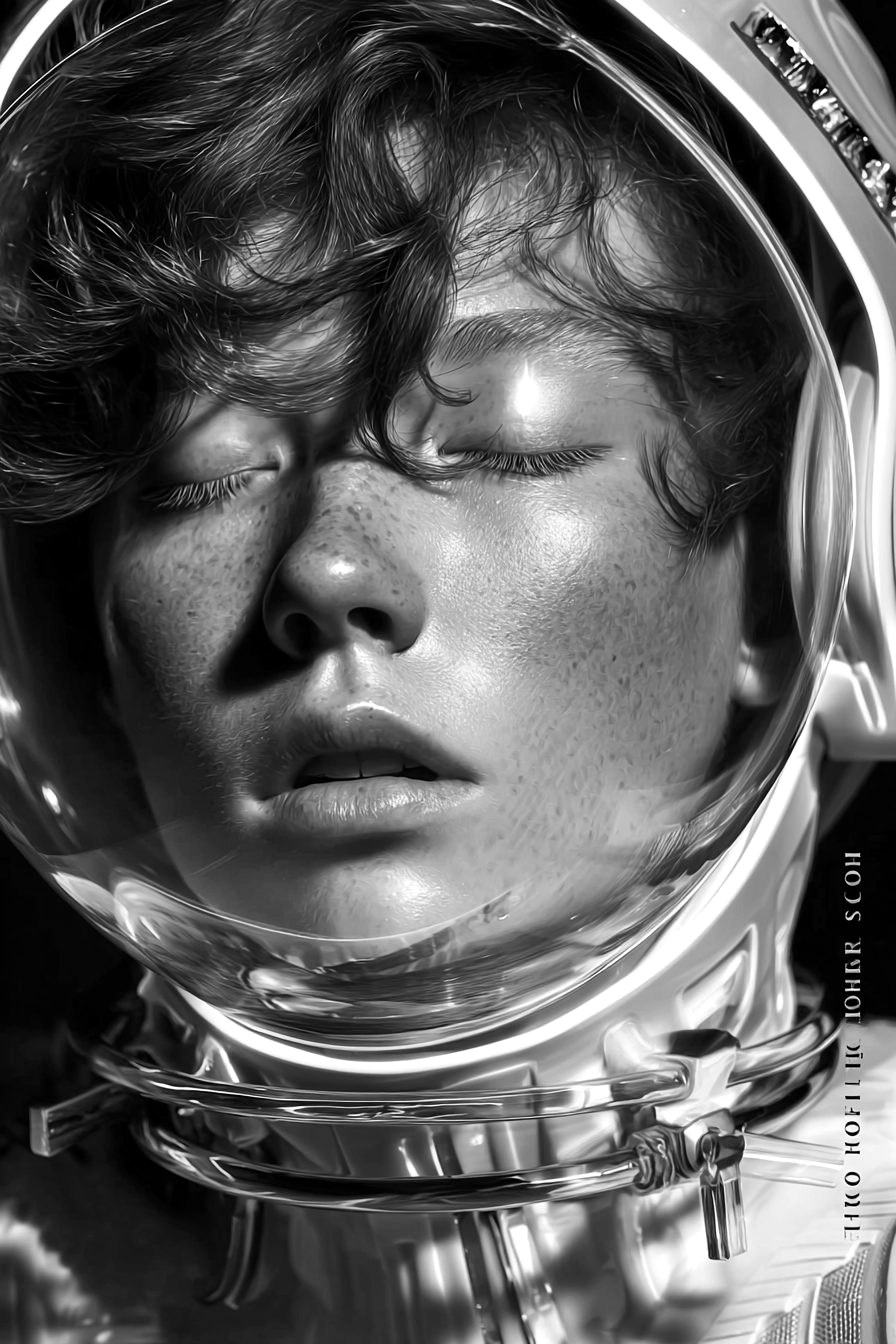
Delta The 30-Minute Descent
Soft brown noise and a low tone that rise and settle like slow breathing — then fade to silence on their own.
How it works

Not a sleeping pill. A dimmer switch.
Music helps people feel they slept better — the stopwatch is less sure. A 2022 Cochrane review of 13 trials (1,007 adults with insomnia) found moderate-certainty evidence that listening to music improves self-rated sleep quality, and low-certainty evidence that it may ease self-reported trouble falling asleep. In the three studies that measured sleep objectively, it did not clearly shorten the time to fall asleep or lengthen sleep.1 Earlier meta-analyses point the same way, with the benefit showing up on questionnaires rather than instruments.2
Why people reach for it. In a survey of 651 people, 62% said they use music to fall asleep — to relax, and to block out noise and their own thoughts. There was no single "sleep sound": what worked was personal.3
Steady noise is the weakest link. A systematic review of 38 studies rated the evidence that continuous noise improves sleep as very low quality, and warned it may also disturb sleep and hearing.4 A 2022 review of 34 studies likewise found no strong evidence for white or pink noise.5 That is why the noise here stays low, sits under 650 Hz, and switches itself off.
The impressive results come from the lab. When short sounds are timed to the brain's own slow waves during deep sleep — with an EEG reading them in real time — slow waves grow stronger and next-day recall improves, in young adults and in 13 adults aged 60–84.6, 7 A track on a phone can't see your brainwaves, and this session doesn't pretend to.
Delta binaural beats: one tiny study. A 3 Hz binaural beat played during sleep lengthened deep sleep in 8 people.8 A 2023 systematic review of 14 EEG studies found binaural beats entrain brainwaves inconsistently — five studies yes, eight no, one mixed.9 Too thin to build a bedtime on, and it would need headphones.
What your brain does after you let go
2. Lights out, press play, screen down. The audio keeps playing with the screen locked on most phones.
3. Breathe with the swell while you're awake. When you drift, stop following it. At 30 minutes it reaches silence — there is nothing to switch off.
ECHO.11 is a self-care tool, not a medical device, and nothing here is medical advice. This session is not a diagnosis, a treatment, or a substitute for care from a doctor or sleep specialist. If you regularly struggle to fall or stay asleep for weeks at a time, talk to a doctor: the first-line treatment for chronic insomnia is a structured therapy called CBT-I, not a sound. Loud snoring, gasping at night or heavy daytime sleepiness are also worth a doctor's visit.
Response varies from person to person, and some people notice nothing at all. That is a normal outcome, not a failure on your part.
Keep the volume low and the phone at arm's length rather than under the pillow. Don't use it while driving. If the sound keeps you awake instead, turn it off — silence is a perfectly good way to fall asleep.
The research described on this page reports what studies have observed in general — not what will happen to you, and no efficacy figures are claimed for this specific recording.
This is not a crisis service. If you are in danger or thinking about harming yourself, contact your local emergency number or a crisis line right away.
- Jespersen KV, Pando-Naude V, Koenig J, Jennum P, Vuust P. Listening to music for insomnia in adults. Cochrane Database of Systematic Reviews 2022, CD010459. doi.org/10.1002/14651858.CD010459.pub3
- Feng F, Zhang Y, Hou J, et al. Can music improve sleep quality in adults with primary insomnia? A systematic review and network meta-analysis. International Journal of Nursing Studies 2018;77:189–196. doi.org/10.1016/j.ijnurstu.2017.10.011
- Trahan T, Durrant SJ, Müllensiefen D, Williamson VJ. The music that helps people sleep and the reasons they believe it works. PLOS ONE 2018;13(11):e0206531. doi.org/10.1371/journal.pone.0206531
- Riedy SM, Smith MG, Rocha S, Basner M. Noise as a sleep aid: a systematic review. Sleep Medicine Reviews 2021;55:101385. doi.org/10.1016/j.smrv.2020.101385
- Capezuti E, et al. Systematic review: auditory stimulation and sleep. Journal of Clinical Sleep Medicine 2022;18(6):1697–1709. pubmed.ncbi.nlm.nih.gov/34964434
- Ngo HV, Martinetz T, Born J, Mölle M. Auditory closed-loop stimulation of the sleep slow oscillation enhances memory. Neuron 2013;78(3):545–553. doi.org/10.1016/j.neuron.2013.03.006
- Papalambros NA, Santostasi G, Malkani RG, et al. Acoustic enhancement of sleep slow oscillations and concomitant memory improvement in older adults. Frontiers in Human Neuroscience 2017;11:109. doi.org/10.3389/fnhum.2017.00109
- Jirakittayakorn N, Wongsawat Y. A novel insight of effects of a 3-Hz binaural beat on sleep stages during sleep. Frontiers in Human Neuroscience 2018;12:387. doi.org/10.3389/fnhum.2018.00387
- Ingendoh RM, Posny ES, Heine A. Binaural beats to entrain the brain? A systematic review of the effects of binaural beat stimulation on brain oscillatory activity, and the implications for psychological research and intervention. PLOS ONE 2023;18(5):e0286023. doi.org/10.1371/journal.pone.0286023
- Diekelmann S, Born J. The memory function of sleep. Nature Reviews Neuroscience 2010;11:114–126. doi.org/10.1038/nrn2762
- Xie L, Kang H, Xu Q, et al. Sleep drives metabolite clearance from the adult brain. Science 2013;342(6156):373–377. doi.org/10.1126/science.1241224
- Fultz NE, Bonmassar G, Setsompop K, et al. Coupled electrophysiological, hemodynamic, and cerebrospinal fluid oscillations in human sleep. Science 2019;366(6465):628–631. doi.org/10.1126/science.aax5440
Also cited above: Lehrer PM, Gevirtz R. Heart rate variability biofeedback: how and why does it work? Frontiers in Psychology 2014;5:756 (doi) · Tsai HJ, Kuo TBJ, Lee GS, Yang CCH. Efficacy of paced breathing for insomnia. Psychophysiology 2015;52(3):388–396 (doi) · Mukhopadhyay C, et al. A comparative analysis of bacterial growth with earphone use. Online Journal of Health and Allied Sciences 2008;7(2):4 (link).